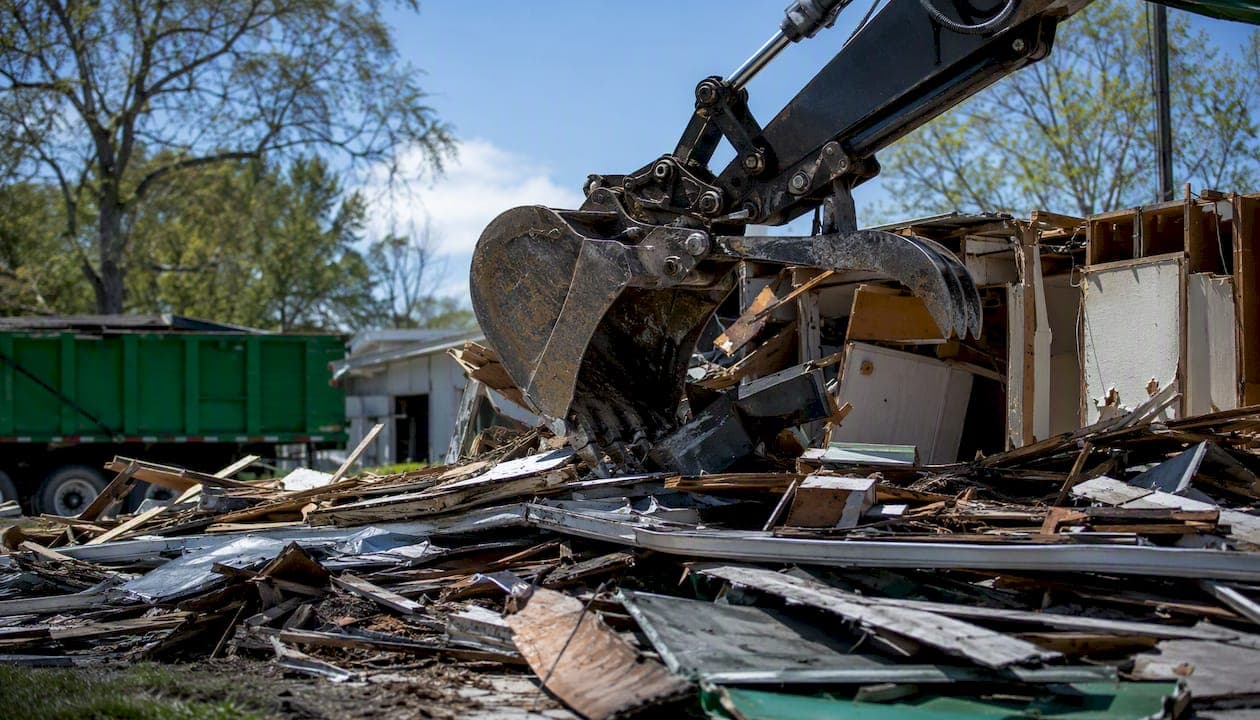
If you're staring down an old mobile home wondering what it'll take to get rid of it, here's the short version: full demolition typically runs $3,000 to $15,000, and it's usually the right call when the unit is pre-1976 (before the HUD Code), storm-damaged, or too deteriorated to move or sell. Expect asbestos and lead testing before any permit gets issued if the home was built before 1980, and plan on roughly two to five weeks from your first permit application to a clean, graded lot.
That price range isn't fixed. If your home can be salvaged for parts, relocated to a new site, or donated to a nonprofit, you could pay far less than the top of that bracket, or in some cases pay nothing at all. Here's what determines where you land.
- Typical demolition cost: $3,000 to $15,000, depending on size, access, and hazardous materials
- Hazard testing: Asbestos and lead surveys are standard for units built before 1980
- Timeline: Permits take one to three weeks; the physical teardown usually takes one to three days
- Cost offset: Salvaging the steel chassis and appliances can shave hundreds off your final bill
Key Takeaways
Full demolition of a mobile home typically costs $3,000 to $15,000, and hiring a licensed, full-service contractor is the surest way to keep permits, hazmat testing, and disposal documentation in order.
| Point | Details |
|---|---|
| Assess condition and title first | Determine if the home is salvageable, relocatable, or truly demolition-only before requesting quotes. |
| Get multiple itemized quotes | Collect two to three written estimates that separate permits, hazmat testing, and hauling costs. |
| Schedule hazmat testing early | Order asbestos and lead surveys before demolition day if your home predates 1980. |
| Verify licensing and insurance | Confirm contractor credentials and request proof before signing any agreement. |
| Book a full-service contractor | Dump Co. Solutions coordinates permits, hazmat, demolition, hauling, and disposal documentation under one estimate. |
Table of Contents
- Mobile Home Removal Cost Breakdown
- Should You Sell, Relocate, Deconstruct, or Demolish?
- What Happens During a Mobile Home Demolition Job?
- Do You Need a Permit and Asbestos Test to Demolish a Mobile Home?
- What Drives the Price of a Mobile Home Demolition Up or Down?
- Can You Demolish a Mobile Home Yourself?
- How Do You Pick the Right Demolition Contractor?
- Why Full-Service Demolition Usually Beats Piecing It Together Yourself
- Get an On-Site Estimate for Your Mobile Home Removal
- Where to Verify Local Permit and Disposal Rules
- Frequently Asked Questions
- Sources
Mobile Home Removal Cost Breakdown
Before you call a single contractor, it helps to know how the four main removal paths stack up against each other in price. Demolition sits in the middle of the pack cost-wise, but it's not always the cheapest or the most expensive option once you factor in permits, hauling, and what you can recover in scrap value.
- Full demolition typically costs $3,000 to $15,000, with most single-wide jobs on open lots landing in the lower half of that range.
- Deconstruction and salvage, where usable materials get pulled and sold or donated before teardown, can trim your net cost since you're not paying to landfill everything.
- Relocation and haul-off pricing often lands in a similar band to demolition, but it only works if the home is structurally sound enough to survive the move.
- Permit fees, asbestos testing, and landfill tipping fees are frequently quoted as separate line items that push your total above the base demolition estimate.
| Removal Method | Typical Cost Range | What's Usually Included |
|---|---|---|
| Full demolition | $3,000 to $15,000 | Teardown, hauling, disposal, basic grading |
| Deconstruction & salvage | Often lower net cost | Material recovery, partial teardown, resale/donation |
| Relocation/haul-off | Comparable to demolition | Transport prep, hitching, hauling to new site |
| Permits & hazmat testing | Added line items | Permit fees, asbestos/lead survey, abatement if needed |
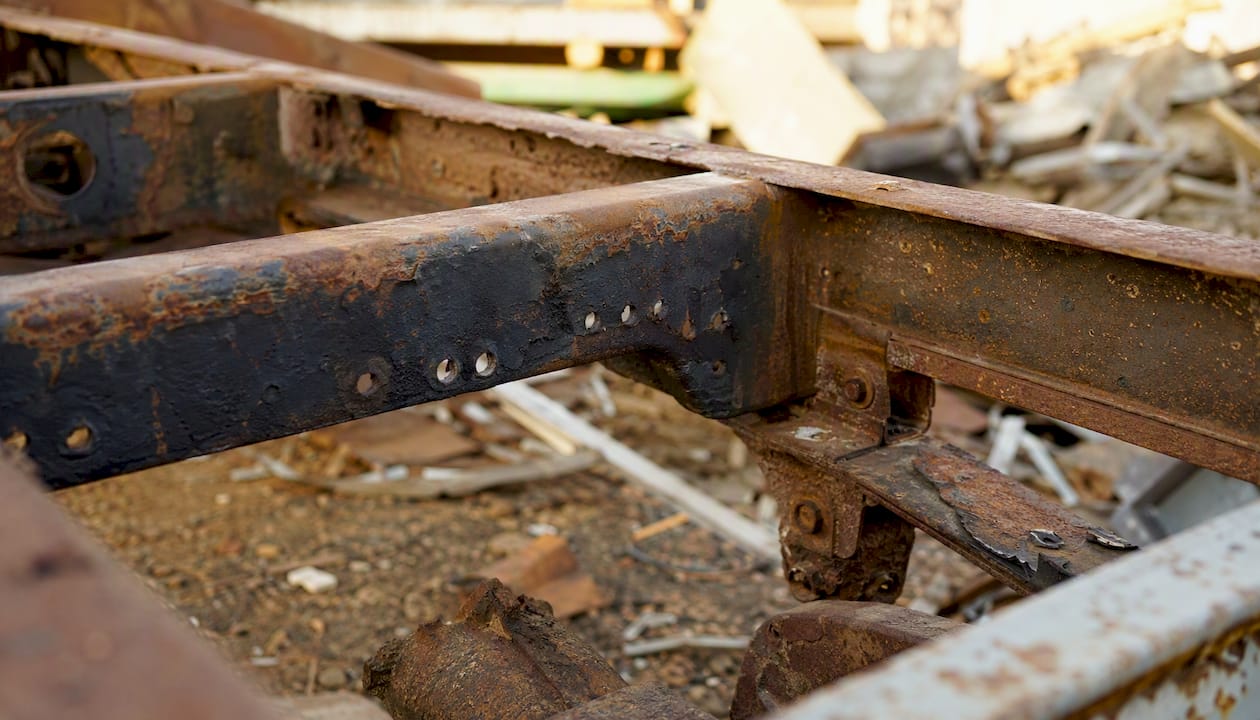
One detail a lot of homeowners miss: the steel chassis underneath your mobile home has real scrap value. Contractors often credit that recovered metal back against your invoice, which is one reason two quotes for the same job can differ by a few hundred dollars.
Should You Sell, Relocate, Deconstruct, or Demolish?
You've got four real paths forward, and the right one depends heavily on the home's age, condition, and your local park rules. Walking through each helps you avoid paying for demolition when a cheaper option would've worked just fine.
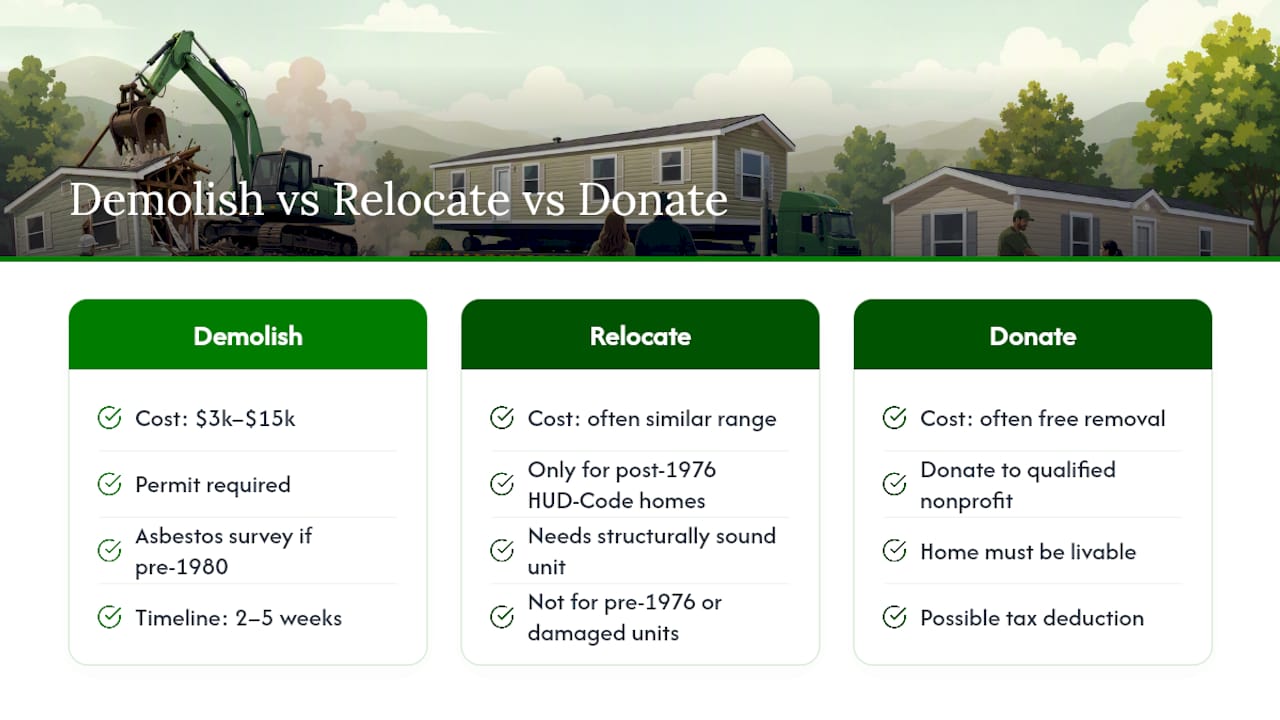
Donate or sell it. If the home is livable and someone wants it as-is, donating it to a qualified nonprofit can mean free removal plus a tax deduction, which beats paying thousands for teardown. This only works if the unit passes basic livability standards and the nonprofit has a truck lined up to move it.
Relocate or haul it off. A post-1976 HUD-Code home in good structural shape is often a candidate for relocation rather than demolition, and pricing can run close to what demolition costs. Pre-1976 units, or anything with a compromised frame or water damage, usually can't survive the trip.
Deconstruct and salvage. This means pulling doors, cabinets, appliances, fixtures, and metal before the structure comes down. It takes longer than straight demolition but can lower your net disposal cost, especially on larger double-wides with usable interior finishes.
Full demolition. This is your answer for derelict, fire-damaged, or heavily deteriorated units, especially anything built before the 1976 HUD Code that can't legally or safely be relocated.
- Donate/sell: best for livable homes with no major structural issues
- Relocate: best for sound post-1976 units moving to a new pad
- Deconstruct: best for units with resalable materials and no rush on timeline
- Demolish: best for derelict, pre-1976, or storm-damaged homes
Pro Tip: Check your park's rules before you commit to any option. Some parks require a demolition permit even for relocation prep, and others won't allow a home to leave the lot without proof of utility disconnection first.
What Happens During a Mobile Home Demolition Job?
A professional demolition follows a fairly predictable sequence, and knowing it ahead of time helps you spot a contractor who's cutting corners.
- Site assessment and estimate. A contractor walks the lot, checks access for equipment, and gives you a written quote. This usually takes a day or two to schedule and complete.
- Permit application. Your contractor pulls the demolition permit through the local building department. This step commonly takes one to three weeks, depending on how backed up your jurisdiction is.
- Utility disconnection. Water, sewer, electric, and gas all need to be safely capped or removed before any equipment touches the structure.
- Hazardous-material screening and abatement. If your home predates 1980, expect an asbestos survey and possibly a lead check, with certified abatement scheduled before demolition day if anything comes back positive.
- Physical demolition. Crews bring in an excavator to tear down the structure. A single-wide on an open lot often wraps in a day, while double-wides, park models, or tight-access sites can take one to two days longer.
- Material separation and hauling. The steel chassis gets pulled for scrap, wood and other recyclables get sorted, and everything else heads to the landfill. Reputable contractors keep dump receipts and disposal documentation throughout this stage.
- Lot cleanup and grading. The final step levels the site so it's ready for a new structure, gravel pad, or simply a clean, sellable lot.
Pro Tip: Before the crew shows up, clear out appliances, furniture, and personal items you want to keep, remove any skirting panels yourself if you're trying to save on labor costs, and move vehicles or trailers blocking the driveway. Every hour a crew spends working around your stuff gets billed.
Do You Need a Permit and Asbestos Test to Demolish a Mobile Home?
Yes, in nearly every jurisdiction, and skipping this step is the fastest way to turn a $5,000 job into a legal headache. Here's what to have in hand before demolition day.
- Demolition permit from your local building department, pulled before any equipment arrives on site.
- Asbestos survey report, especially for homes built before 1980, since licensed contractors routinely require this testing before they'll schedule the job.
- Certified abatement documentation if asbestos or lead is found, proving a licensed abatement crew handled removal.
- Landfill or disposal receipts, which some jurisdictions require as proof the debris was disposed of legally.
- Air-district notification, required in some areas before demolishing older units, particularly if asbestos-containing materials are present.
Older mobile homes, particularly those built before 1980, carry a real risk of asbestos in flooring, siding, and insulation. Certified testing and abatement aren't optional extras. They're the difference between a legal, documented teardown and a stop-work order that costs you weeks and thousands in fines.
Skipping permits or hazmat testing doesn't just risk a fine. It can trigger a stop-work order mid-project, forcing you to pay for testing and abatement anyway, plus whatever delay penalties your contractor charges for a paused job. Ask for copies of every permit and report before you sign off on final payment.
What Drives the Price of a Mobile Home Demolition Up or Down?
Two quotes for what looks like the same job can differ by thousands of dollars, and it almost always comes down to a handful of factors.
- Size and unit type. A single-wide costs less to tear down than a double-wide or park model simply because there's more material and more labor involved.
- Site access. Tight lots, narrow driveways, or homes wedged between other units in a park require smaller equipment and more careful staging, which adds time and cost.
- Hazardous materials. Asbestos or lead abatement is one of the biggest swing factors. A clean, hazard-free teardown can cost half of what a home requiring certified abatement runs.
- Foundation type. Homes on permanent foundations or with added additions (decks, carports, sheds) take longer to fully clear than a simple pier-and-beam setup.
- Hauling distance to the landfill. Rural areas far from a disposal site pay more in trucking time and fuel than homes near an urban transfer station.
If you want to know which factors usually double a quote versus which ones just nudge it up slightly: hazardous-material abatement and poor site access are the two that most often blow past your original estimate. Size alone rarely doubles a price, but asbestos remediation regularly does. On the flip side, salvage credit from the scrap steel chassis and working appliances can claw some of that cost back, sometimes by several hundred dollars depending on current scrap metal prices.
Can You Demolish a Mobile Home Yourself?
Technically, some of the prep work is fair game for a homeowner with a truck and a free weekend. The actual teardown almost never is, and here's why that distinction matters for your wallet and your safety.
What you can typically handle yourself:
- Removing skirting panels and exterior trim
- Clearing out personal belongings, furniture, and appliances you want to keep
- Cutting back landscaping or fencing around the unit for equipment access
- Disconnecting simple items like window units or satellite dishes
What almost always requires a licensed contractor:
- Utility disconnection (electric, gas, water, sewer)
- Asbestos or lead abatement
- Operating heavy equipment like excavators
- Pulling and closing out the demolition permit
Homeowners who skip licensed contractors for the heavy work expose themselves to real liability. If you're injured operating rented equipment, or if you disturb asbestos without proper containment, you're personally on the hook, and most homeowner's insurance policies won't cover injuries from unlicensed demolition work. DIY prep work can shave a modest amount off your total bill, mostly in labor hours, but the structural teardown itself carries risks that routinely turn a cost-saving attempt into a far more expensive repair or medical bill.
Statistic Callout: Full demolition and removal costs typically fall between $3,000 and $15,000, and that range already assumes licensed labor and proper disposal. DIY teardown rarely gets you below the floor of that range once you account for equipment rental and landfill fees, but it does significantly raise your personal risk.
How Do You Pick the Right Demolition Contractor?
A written, itemized quote is your best defense against surprise costs, and it's also the fastest way to spot a contractor who isn't set up to do this legally.
Contractor checklist before you sign anything:
- Verify active licensing and insurance, and ask to see certificates directly rather than taking their word for it.
- Confirm they use a licensed asbestos abatement subcontractor if your home predates 1980.
- Request a written, itemized quote that separates permit fees, hazmat testing, hauling, and landfill disposal.
- Ask for dump receipts and a disposal plan showing where debris and hazardous material actually go.
- Request references and photos from at least two or three past mobile home demolition jobs.
Questions to ask on your first call:
- Are you licensed and insured for demolition work in this county?
- Who handles the asbestos survey, and is that cost included in your quote?
- What's your typical timeline from permit application to a cleared lot?
- Do you provide landfill receipts and abatement documentation after the job?
Red flags that should make you walk away:
- No written quote, or a quote that's a single lump-sum number with no breakdown
- Vague answers about where debris will be disposed
- No proof of insurance when asked directly
- Any suggestion that you can skip the permit to save time or money
| Line Item | What It Typically Covers |
|---|---|
| Site assessment | Walkthrough, access evaluation, written estimate |
| Permit fees | Local demolition permit application and processing |
| Hazmat testing/abatement | Asbestos and lead survey, certified removal if needed |
| Demolition labor & equipment | Excavator operation, teardown, crew hours |
| Hauling & disposal | Debris removal, landfill tipping fees, dump receipts |
| Lot grading | Final site leveling and cleanup |
Crews experienced in tight park demolitions typically run multiple similar jobs each week, which usually translates to faster turnaround and fewer surprises for you, since they've already worked out the logistics of narrow access and neighbor coordination.
Why Full-Service Demolition Usually Beats Piecing It Together Yourself
Coordinating a mobile home teardown yourself means juggling a permit office, an asbestos testing company, a demolition crew, a hauling service, and a landfill, and if any one of those links drops the ball, you're the one holding the delay. That's the real value of hiring a single, full-service contractor for a job like this: one accountable party handling permits, hazmat coordination, teardown, hauling, and disposal documentation, instead of you playing project manager across five different vendors.
Dump Co. Solutions offers licensed and insured demolition services for sheds, decks, interiors, and concrete removal, and that same full-service approach carries over to mobile home teardown work. Same-day and next-day scheduling options mean you're not waiting weeks just to get someone out to look at the site. Locally owned operations also tend to know the permitting quirks of their own county better than an out-of-state broker ever will.
The value isn't just convenience. It's documented, defensible disposal that protects you if questions ever come up later about where the debris went or whether hazardous materials were handled properly.
Get an On-Site Estimate for Your Mobile Home Removal
You've seen how many moving parts a mobile home teardown involves: permits, hazmat testing, hauling, disposal receipts, and lot grading, all coordinated across multiple vendors if you go it alone. Dump Co. Solutions handles that entire chain under one roof.

Our team offers on-site assessments, permit handling, utility coordination, hazardous-material screening, full demolition, debris hauling, and final lot grading, all backed by licensed and insured crews. If you'd rather stage debris removal yourself before a demolition crew arrives, our dumpster rental options give you a roll-off sized for the job. Every estimate comes itemized and in writing, with disposal receipts and abatement coordination documented when hazardous materials are involved, so you're never left guessing where your money went or where your debris ended up.
If you're in the Jacksonville area and ready to move forward, request an on-site estimate through our main services page or check out coverage in areas like Southside and Mandarin. Same-day and next-day scheduling means you could have a firm quote in hand within a day or two of calling.
Where to Verify Local Permit and Disposal Rules
Permit requirements, hazmat notification rules, and disposal fees vary by county and even by city, so treat every cost and process detail here as a starting point rather than the final word for your specific address.
- The LocalMovers.com cost guide breaks down removal options and pricing across different scenarios.
- Wayne County's Mobile Home Program is a useful example of a government-run deconstruction option for abandoned units, though eligibility and funding vary by county.
- Demo Patrol's licensed removal guide covers asbestos survey requirements and air-district notification rules for older homes.
- For construction debris handling on larger properties, Sparkle Pro's guide for property managers offers practical disposal planning tips.
Contact your local building department directly to confirm current permit fees and asbestos notification thresholds, since these details change by jurisdiction and sometimes year to year. Keep copies of every permit, dump receipt, and abatement report. If a dispute ever comes up about how debris was handled, that paperwork is your protection.
Frequently Asked Questions
How much does it cost to demolish a mobile home? Full demolition typically runs $3,000 to $15,000, depending on the home's size, site access, and whether hazardous materials like asbestos need certified abatement.
Do I need a permit to demolish a mobile home? Yes, nearly every jurisdiction requires a demolition permit before teardown begins, and homes built before 1980 typically also require an asbestos survey as part of that process.
Is it cheaper to relocate a mobile home than to demolish it? Relocation pricing often lands in a similar range to demolition, but it only works for structurally sound, post-1976 HUD-Code homes. Pre-1976 or damaged units usually can't be safely moved.
Can I donate my mobile home instead of demolishing it? If the home is livable, donating it to a qualified nonprofit can mean free removal and a possible tax deduction, which is often cheaper than paying for demolition outright.
How long does mobile home demolition take from start to finish? Permitting usually takes one to three weeks, and the physical teardown itself runs one to three days depending on unit size and site access, putting most projects at two to five weeks total.
What happens to the materials after demolition? Licensed crews typically separate the steel chassis for scrap recycling, sort wood and other recyclables, and document hazardous waste disposal separately, providing dump receipts as proof.
This is general information about mobile home removal and demolition, not a substitute for advice from your local building department or a licensed contractor. Confirm current permit requirements, fees, and hazardous-material rules for your specific address before starting any project.
Sources
- Localmovers
- How to Remove Your Mobile Home and How Much It Costs
- What to Expect During a Mobile Home Demolition | West Coast Land Solutions
- Mobile Home Demolition | Licensed Removal Contractor | Demo Patrol
- Mobile Home Removal NC & SC | Haul-Off or Demolish